Tuesday, May 20, 2014

May 2014 -- An updated kitchen -- pictures

Yes, it was worth the wait!


Last goodbye to the old drawers and sink. I loved those little lights Alessandro put up. Luckily, I was able to salvage them.


I didn't want to witness this destruction phase. The old ice box was left in place. 


Picking out the Carrara marble. Yes, I know it scratches. I love it, anyhow. 


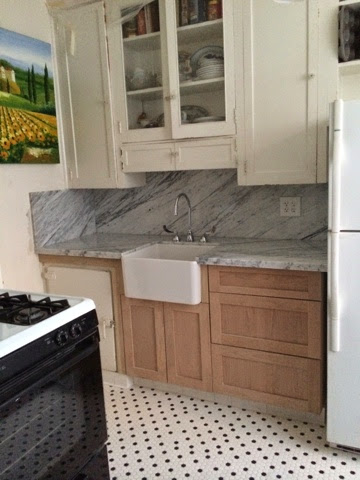
Installation of the 20 inch farmer's sink (imported from Turkey).  The alder wood cabinets are from Pennsylvania but purchased in Orange County. I'd like to believe they were made by Amish carpenters. 


Watching the cut marble arrive! While waiting, I saw Peregrine Falcons nesting on a ledge on the building across the street.


It was carefully tied in.


Tom, the contractor works with the marble artisan and his helper. 


The plastic sheeting held back most of the marble dust. 


First peek and I'm in love!
 

Lining up the faucet and sink. 
 

No regrets! 
 
 
The floor tile is complete. 
 

Dust everywhere. 
 
 
Tile behind the fridge is done. 
 

Sunflowers to welcome the new kitchen
 

Painting will have to follow in a few weeks. First priority is to clean up the entire apartment, wax the hardwood floors and wipe off every book. 

In the meantime, I can cook again. I already have a recipe and ingredients waiting!


I love love love my new kitchen. I know Alessandro would have been crazy about it too.  
 
Thank you to MT Sterling, Inc. (Long Beach, California) and crew for all your hard work and attention to details. 

Monday, May 19, 2014

May 2014 -- An updated kitchen

I've loved my tiny kitchen with its view of the Tuscan countryside. But, it's been overdue for an update for several years. I took the plunge and now it's done.  Well, at least the destruction and construction is complete.  

I retained some of the 1934 charm, but it was necessary to pull out some of the original drawers.  Now I need to deal with the immense cloud of dust which has settled over everything in my small studio apartment. 

Hurray! Now I can cook again. It's been so so difficult being separated from my kitchen.

Friday, May 9, 2014

Not even Montalbano can comfort me!


I've been locked out of my little kitchen for almost 10 days. It's not been easy. I dislike eating fast food and restaurant food. 

Yesterday I finally got running water in my new farmhouse style sink, which I adore!

Meantime, the 2013 Montalbano series has arrived from Italy, but access to my DVD player is blocked by a heavy oak ice box, which is temporarily in my living space. 

The good news, is the Carrara white marble kitchen counter will be installed on Sunday!  

Sunday, April 27, 2014

Schiacciata di Pasqua di Fucecchio (Florentine Easter Bread)

This year I saw a recipe for Schiacciata di Pasqua in the April edition of The Florentine. This fabulous monthly newspaper helps me keep current with news and events in Firenze. The bread looks very much like Panettone which originated from Milano. Instead of candied citrus fruit, it contains anise seed and fresh zest from an orange and a lemon. 

I made the bread Saturday evening, using anise seeds I had bought in Italy. The flour was also 00 farina, which I purchased locally.  I also had some Italian paper baking forms.  I baked it on Easter morning and the air filled with the fragrance of baking anise!  It turned out beautiful and delicious.

The recipe dates back to the 18th century.  In a bit of a modern update, according to my research, it is now often served with pieces of Easter Egg chocolate or a bit of Nutella or hazel nut chocolate spread.


After rising overnight:


~~~.~~~.~~~

The Florentine -- April 2014 issue

Here is the article, copied in its entirety:

Worth the wait

Schiacciata di Pasqua
BY EMIKO DAVIES   (ISSUE NO. 198/2014 / APRIL 3, 2014)
In Italy, traditional Easter desserts are usually egg-rich baked goods. Naples’ Easter sweet is pastiera, a ricotta and wheatberry cake scented with orange blossom and candied citron. In Sicily, it iscassata, a sponge cake layered with ricotta, chocolate and candied fruit. Tuscany’s simpler palate is evident in the Easter schiacciata di Pasqua, a fluffy, sweet, crumbly bread not unlike Milan’s panettone, scented with the unmistakeably Tuscan aroma of aniseed.

There are claims that the schiacciata di Pasqua originated in eighteenth-century Fucecchio, a small town along the Arno roughly equidistant from Florence, Pistoia, Lucca, San Gimignano and Pisa.Schiacciata di Pasqua is indeed found in Tuscan towns from Fucecchio to Pisa to Livorno, and even as far south as San Gimignano. Although often known by different names—sportellina in San Gimignano and stiacciata in Livorno and along the Etruscan coast, and even pizza in other areas from southern Tuscany into central Italy—the ingredients are essentially the same, with aniseed the constant in any Tuscan version, but the amounts and other little touches differ.
A long process, the baking of the Easter schiacciata was a tradition of nineteenth-century contadini, the country folks’ way of both using and preserving spring’s abundant eggs. The recipe,
a version of which I offer here, needs to be followed with patience and care,
letting the bread rise slowly and adding the ingredients in at least two stages, sometimes more. (Perhaps this is why today the schiacciata di Pasqua

Ideally, schiacciata di Pasqua should be made on Good Friday, so it is ready to go on the table on Easter Sunday. But, to be honest, it is even better when it is a day or two old. It can be revived when it is even older than that with a little dunking in some vin santo. It goes wonderfully well with broken-up pieces of chocolate Easter eggs, too.

RECIPE
Schiacciata di Pasqua from Fucecchio

Ingredients
500g ‘Type 0’ flour, plus 50 g for the starter / 170g sugar / 85g butter / 20ml olive oil / 4 eggs / 28g fresh yeast (or 9g dry yeast) / 15g aniseed / A splash of vin santo / A splash of Sambuca or Strega (or Marsala’) / Pinch of salt / 1 tsp honey / Juice and zest of half an orange / Zest of 1 lemon

Method
Activate the starter by combining the yeast with about 60ml of lukewarm water and 50g of flour. Let it bubble and rise in a warm place until it has doubled in size, about 20 minutes or so. In the meantime, soak the aniseed in the orange juice together with the citrus rinds and honey. Preheat the oven to warm it up to help the dough rise in the next step. Turn it off before it gets too hot—ideally it should be at least 30–40°C.

The first rising (90 minutes)
When the starter has doubled in size, add to it half of the schiacciata ingredients. In other words: 250g of flour, 85g of sugar, 43g of butter, 1 whole egg, 1 egg yolk (save the white for later), 8 g of olive oil, pinch of salt and half of the aniseed mixture. Combine well to obtain an elastic, slightly sticky dough.

Place the dough in a large bowl, covered, inside the warm oven (which should be turned off). Let the dough rise until it is soft and wobbly—it should tremble like a pudding when lightly shaken. This usually takes about 90 minutes, but this can vary greatly depending on the temperature of the kitchen—it can help to re-light the oven to warm it up more during the 90 minutes.

The second rising (3 hours)
When the dough is appropriately wobbly, add the rest of the ingredients. Combine everything well and then place the dough in a greased (traditionally with lard, but you can use olive oil), round, deep baking tin (around 20–26 cm in diameter). Let the dough rise, covered (even swaddled) in tea towels, in a warmed (but unlit) oven, as before, for another 3 hours or, better, overnight. The dough should rise to about three times its original volume and be perfectly round.

Baking (50 minutes)
Brush the top of the dough with the reserved egg whites and bake in moderate oven (150–160°C) for about 50 minutes until springy and dark brown on top. A small saucepan filled with water and placed in the bottom of the oven will help keep the oven humid and create a nice crust.

To serve
Allow it to cool slightly in the pan before attempting to remove it. Let it cool completely and serve it cut into slices. Enjoy on its own, with a small glass of vin santo or chocolate Easter eggs. The bread will keep well, covered in plastic wrap, for a week.


~~~.~~~.~~~.~~~.~~~.~~~.~~~.~~~.~~~
I did further research and found this article. The recipe, in Italian, is identical. 


Schiacciata di Pasqua - Ricetta e Tradizione
Inserito da admin il Mer, 31/03/2010 - 18:38

La Schiacciata di Pasqua è  tipica della tradizione gastronomica pasquale della Toscana, ed è un dolce povero della cucina contadina e della provincia di Pisa, in particolare delle zone di Fucecchio e San Miniato.

Le origini della schiacciata di Pasqua
La Schiacciata di Pasqua nasce nella seconda metà dell'Ottocento dall'idea delle famiglie contadine, per usare la gran quantità di uova del periodo pasquale  per fare un dolce, che servisse a festeggiare la Pasqua.
La schiacciata veniva preparata nel periodo della Quaresima e fino alla Pasqua di Rose (Pentecoste), quando non c'era molto altro da mangiare. Un vero e proprio pan dolce preparato con la pasta di pane arricchita di uova, zucchero e aromi.
La tipicità é data dal tipo di lavorazione e dalla fermentazione naturale che avveniva  grazie al calore che emanavano una volta i grandi bracieri, con cui anche si cucinava.
Un vecchio documento racconta…
Ogni famiglia la confezionava nella propria casa. Quando la pasta era pronta veniva sistemata nelle teglie di rame. Con i grumi di pasta rimasti le mamme preparavano il "corollo", una ciambella che veniva posta sopra un pezzo di carta oleata. Le teglie con le schiacciate e il corollo venivano messi a lievitare nella madia. La lievitazione però si rivelava sempre molto problematica. E siccome le schiacciate venivano preparate dopo la cena dovevamo vegliarle per vedere se lievitavano. Stabilivamo dei turni. Se a mezzanotte la pasta non si era mossa dovevamo farle fare i fumacchi: mettevamo dentro la madia alcune pentole di acqua bollente e affidavamo al loro vapore acqueo il miracolo della lievitazione. Se il miracolo non avveniva portavamo le schiacciate in "cardana" (un pertugio sopra il fondo) verso le sei di mattina. Al fornaio […] portavamo anche un uovo con il quale doveva spennellare la superficie delle schiacciate prima di metterle in forno. Io non vedevo l'ora di prendere il corollo perché potevamo mangiarlo…
Caratteristiche della Schiacciata di Pasqua
La particolarità di questo dolce sta ancora nel processo di lievitazione naturale che avviene in tre fasi "ritoccando" l'impasto, cioè aggiungendovi in due volte gli ingredienti e grazie al calore sprigionato nella classica madia dai vecchi bracieri, utilizzati in quei tempi anche per scaldarsi.
Il procedimento è piuttosto lungo e delicato; la buona riuscita dipende in larga parte dalla lievitazione che permette alla schiacciata di divenire soffice e leggera. Tutto il processo deve essere svolto in un luogo molto caldo e umido, privo di correnti d'aria o di sbalzi di temperatura. 
Dolce, oltre che sublime al palato, assolutamenteequilibrato con pochi grassi e non moltissime calorie. Ha la forma del panettone ma il sapore è molto più delicato con una dolcezza non troppo spiccata.
La Schiacciata è ottima accompagnata con il vin Santo, con la cioccolata delle uova di Pasqua per la merenda, ma perfetta anche inzuppata nel latte, per la prima colazione.

Ricetta della Schiacciata di Pasqua
Ingredienti:
per 3 schiacciate da 1 Kg ciascuna:
  • Farina 1500 g
  • Zucchero 500 g
  • Burro 250 g
  • Olio extravergine di oliva toscano 50 g
  • Uova 8 (5 intere, 3 tuorli e 3 chiare per spennellare da mettere da parte)
  • Lievito di birra 85 g
  • Anici 45 g
  • Vin Santo metà bicchierino da liquore
  • Liquore tipo Sambuca, Strega o Rosolio di menta 1 bicchierino
  • Sale 5g
  • Miele 1 cucchiaio
  • 1 arancio e 1 limone
Tempo di preparazione e cottura: 18 h circa, dipende dai tempi di lievitazione
Preparazione
1° lievito o lievitino bianco
Sciogliete 85 gr. di lievito in una tazza da circa125 g riempita di acqua o latte tiepidi e lavoratelo con circa 150 g circa di farina di grano tenero tipo "0". Lasciate lievitare finché non forma tante bollicine e comunque raddoppia di volume, coperto con un panno al caldo in una madia (circa 20 minuti), utilizzando una pentola di acqua calda per infondere il calore necessario.
Mettete gli anici ad ammorbidire nel succo di arancia e limone con la buccia grattugiata di entrambi e 1 cucchiaio di zucchero semolato (in sostituzione si può utilizzare l'essenza di anici).
2° lavorazione o primo ritocco (dopo circa 20 minuti)
Unite al lievitino metà di tutti gli ingredienti: 750 g di farina, 2 uova intere e 2 tuorli, 250 g di zucchero, 125 g di burro leggermente ammorbidito, 25 g di olio extravergine di oliva, 22 g di anici, ½ Vin Santo e Sambuca, un pizzico di sale, miele, ½ arancia e ½ limone grattugiati.
Lavorate a mano o con l'impastatrice finché l'impasto non diventa setoso ed omogeneo. La consistenza è morbida. A questo punto mettere a lievitare in forno al minimo (min. 30/40°).
I tempi di levitazione non sono misurabili esattamente, dipende molto dalla temperatura del forno. La lievitazione è ottimale quando il composto diventa tremolante tipo un budino (dopo circa 1 ora/1 ora e ½). 
3° lavorazione o secondo ritocco (dopo circa 1h-1h e ½)
Unite il resto degli ingredienti e impastate come nella fase precedente. Questa lievitazione viene fatta nelle teglie (3 da 18 cm di diametro) dove poi avverrà la cottura. Quindi prendete l'impasto, versatelo su una base di marmo unta di olio, dividete l'impasto in tre e disponetelo nelle teglie unte con strutto di maiale. Rimettete a lievitare come al solito nel forno.
Questa è la parte più delicata perché se non lievitano correttamente il risultato sarà compromesso.
Al temine della lievitazione, dopo circa 3 ore, estraete le teglie dal forno, mettete un pentolino con acqua e portate il forno a 160° circa.
Spennellate le schiacciate con le chiare d'uovo messe da parte e mettetele ancora in forno per circa 50 minuti a 160° circa. A cottura ultimata, lasciatele riposare 10/15 minuti, quindi estraetele e disponetele su un tagliere di legno finché non freddano, poi riporle in un sacchetto di naylon.
Si mantengono molto bene per tutta la settimana di Quaresima.


Sunday, March 30, 2014

Saturday, March 29 -- Making Gnocchi at the Italian Cultural Institute (Gnocchi di patate)

It's Saturday, March 29 and the last day of a 10 week session of Italian classes at the IIC, the Istituto Italiano di Cultura in West Los Angeles. Today, our class Italiarama had a cooking class. It turned into a real feast of wonderful food. 

Michele, our maestro, agreed to teach us how to make his mother's gnocchi di patate. I think it's been two years since Michele last taught this recipe. He always varies each set of 10 lessons so they are unique, because so many of us are repeat students. We are all so ready and enthusiastic for this gnocchi experience. 

This morning at 7.30, I began making focaccia. It is of course not 100% authentic, but it's as close as I've been able to recreate the focaccia I love from Liguria and Tuscana. It's thinner, crispier and plainer than what Americans call focaccia

I arrived early this morning for school. I found Michele in the kitchen area, seated at the glass table. He was just ending a private lesson. When I showed him the focaccia, right away, he said it's focaccia like they make in Firenze. He knows my heart has never left Firenze!

His Italian approval made me so happy and it sent Michele off on a tangent. This week during a class (on the second floor), he heard music, one of his favorite songs. Someone downstairs was rehearsing for an upcoming event.  He wanted us to hear that music. On his laptop, he started this Youtube clip 'Parlami di Firenze' for us to watch while he collected his cooking class materials from his car. 

Parlami di Firenze (Italian Lyrics below)

This is a perfect example of why I keep repeating this class, Italiarama. Michele has an amazing talent of sharing parts of his culture that go beyond just learning vocabulary, phrases and grammar rules of the language. 

Our class began arriving, each student bringing with a bag containing some type of Italian food.


Michele shows us the potatoes he riced last night.  Grazie Michele!  He was up until midnight preparing the potatoes.  The whole russet potatoes need to be boiled in water with a pinch of salt. 
Do not overboil the potatoes so they become water logged. 
Then, when the potatoes test tender with a fork, drain and peel them. Immediately rice them, while they are still warm.  He cautions that these potatoes he made, have probably dried out over night and we will need to use less flour than the recipe calls for.


The recipe is facile, easy!  1 kilo of russet potatoes and 300 g of 00 flour.  We used Italian 00 farina (flour) which I had purchased at Bay Cities Deli in Santa Monica.  We did not use all the flour, just as Michele predicted.


I noticed Michele was using a squeezing force to mix the potatoes and flour.  He was not kneading, as one would knead bread dough.


These gnocchi were the best I have ever eaten!  The texture was just a bit firmer than mashed potato.  They were not hard nor gummy.


Buon appetito! (Enjoy your meal!)


These treasures were hand-made by Janna.  They are Galani, a Venetian carnival dessert.  Wow!  Authentic, beautiful and delicious.  Grazie Janna.  As soon as I saw these, I knew the amount of work which had gone into making them.


Two yummy torte which had been purchased at Le Pain Quotidien.  


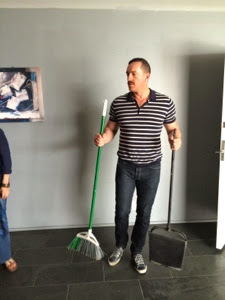
Like Cinderella, we needed to be OUT of the Istituto at 2 pm sharp!  We worked quickly doing a thorough clean-up.

Alessandro took several cooking classes here with me.  He was amazed and impressed with American teamwork, which seems to be ingrained in us from childhood.

Everyone pitches in without being assigned any particular job and the kitchen looks better than we found it. 


Gnocchi

1 kilo russet potatoes
300 g flour  (try to use 00 Italian flour)

Pecorino, finely grated

Pomi boxed Italian chopped tomatoes
Pomi boxed Italian tomato sauce
2 T Olive oil
2 garlic cloves, smashed
Dash of hot red pepper flakes
A handful of fresh basil 
Salt to taste 

Boil the unpeeled potatoes with a pinch of salt.  When the potatoes test fork tender, remove them from the water and peel them.  Rice the potatoes while they are still warm.

Mix the potatoes with 2/3s of the flour, adding more if needed.  Some of the flour will be used to dust the bread board.  Do not over mix or add too much flour.  If your gnocchi are too firm, you added too much flour.

Cut pieces of the dough and roll into thin strips.  Cut into pieces.  Roll each piece over fork tongs or if you are lucky to have one, a small wooden tool which was designed for this purpose.  

Set gnocchi aside on floured trays.  (at this point gnocchi can be frozen)

When a large pot of water has come to a boil, lightly salt the water.  Add gnocchi to the water.

Gnocchi will float when they are done.  Pull them out as they rise to the surface and place them on a plate or pan containing a bit of sauce, to which finely grated fresh pecorino has been added.

Tomato Sauce:

Saute the garlic in olive oil.  Remove the cloves, when they begin to brown.
Add hot pepper flakes
Add boxed tomato
Add whole basil leaves

Simmer sauce while the gnocchi are cooking in the water.  

Note:  Gnocchi can be served with other sauces.  Another variation is Gnocchi alla Sorrentina, which adds fresh mozzarella to the tomato sauce, just at serving.


~~~.~~~.~~~
Notre Dame de Paris 

Music: Riccardo Cocciante
Italian Lyrics: Pasquale Panella

Act II


Parlami di Firenze


Lyrics:

FROLLO

Parlami di Firenze
E della Rinascenza
Novità di Bramante
E di Stilnovo e Dante

GRINGOIRE

Si racconta a Firenze
Che la terra è rotonda
E che c'è un continente
Alla fine del mondo

FROLLO

Navi vanno laggiù e cercano nel vento
Il nuovo orientamento della rotta alle Indie 


FROLLO C'è Lutero che inventa un Nuovo Testamento
E noi siamo all'alba di un mondo che si scinde

GRINGOIRE

Si dice che Gutemberg
Cambia il modo di capire

FROLLO

Con le presse a Norimberga
Sta stampando l'avvenire

GRINGOIRE

Sulla carta poesie
Tesi, satire, eresie

FROLLO, GRINGOIRE

L'aria nuova farà
Nuovo chi la vivrà

GRINGOIRE

Ogni piccola cosa ucciderà le grandi
Il libro ucciderà altari e cattedrali


FROLLO

La stampa imprimerà la morte sulla pietraLa Bibbia sulla Chiesa e l'uomo sopra Dio

E questo uccide quello

FROLLO, GRINGOIRE

Navi vanno laggiù e cercano nel vento
Il nuovo orientamento della rotta alle Indie C'è Lutero che inventa un Nuovo Testamento E noi siamo all'alba di un mondo che si scinde L'aria nuova farà
Più nuovo chi vivrà

Watch the full two hour musical here: